

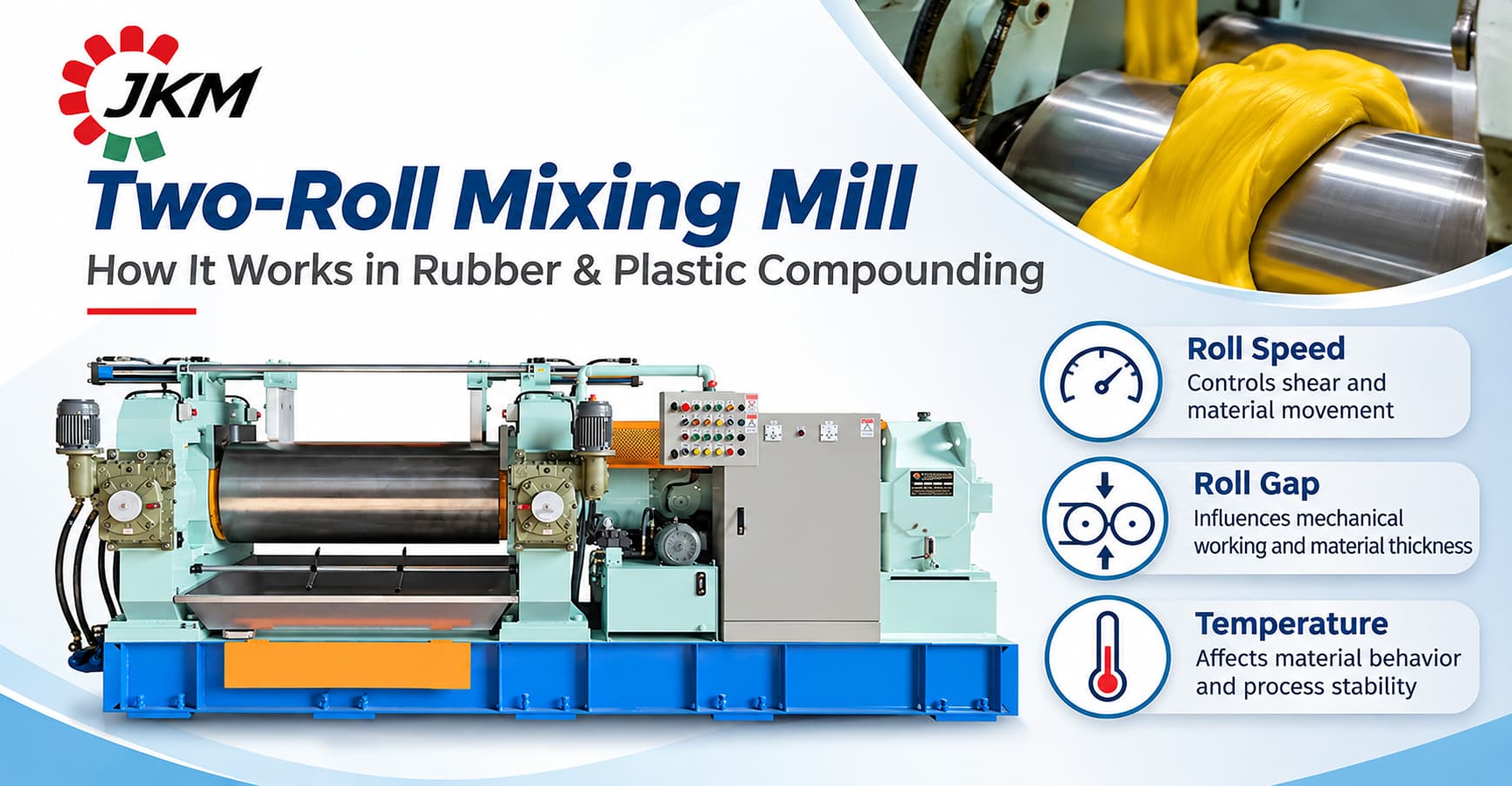
A two-roll mixing mill, also called a two-roll mill, mixing mill, or mixing roller, uses two rotating rolls to mix, knead, and disperse rubber and suitable plastic compounds.
For B2B buyers, the key questions are practical: Can the mill process the intended material? What mixing conditions affect dispersion? What machine size and configuration are required? And how does the mixing stage fit into the overall production process?
Jian Kwang's Mixing Roller is designed for rubber and plastic processing, including product R&D, product improvement, color mixing tests, mixing, and kneading.
What Is a Two-Roll Mixing Mill?
A two-roll mixing mill processes material between two parallel rotating rolls. As the compound passes through the working area, it is repeatedly worked to mix ingredients and improve their distribution throughout the material.
The equipment may be referred to as a two-roll mill, mixing mill, rubber mixing mill, or mixing roller, depending on the manufacturer and application. Because terminology varies, buyers should evaluate the actual machine configuration and intended application rather than relying on the equipment name alone.
When Should You Use a Two-Roll Mixing Mill?
A two-roll mill is useful when the process requires mixing and kneading while allowing the operator to directly observe and work with the material.
Typical applications include:
- Product and formulation development
- Product improvement
- Color mixing and evaluation
- Material mixing and kneading
- Testing before larger-scale production
Jian Kwang also provides laboratory mixing rollers for manufacturers that need to test small quantities of raw materials and additives before moving into mass production.
What Materials Can Be Processed on a Two-Roll Mill?
Two-roll mills are commonly used for rubber and suitable plastic compounds, but machine selection should not be based on the material name alone.
Different formulations respond differently to heat and mechanical working. Fillers, pigments, additives, and other ingredients can also change how a compound behaves during mixing.
Before selecting a machine, provide the equipment manufacturer with:
- Base material
- Additives or fillers
- Required processing quantity
- Processing temperature requirements
- Purpose of the mixing process
- Downstream production process
This information provides a more reliable basis for equipment selection than simply specifying “rubber” or “plastic.”
How Does a Two-Roll Mixing Mill Work?
Material is fed into the working area between the rolls. As the rolls rotate, the compound is mechanically worked and repeatedly returned through the mixing area.
This repeated action helps distribute ingredients throughout the compound. The actual mixing result, however, depends on more than the basic machine principle. Roll speed, roll gap, temperature, mixing time, and formulation all influence how the material behaves during processing.
How Do Roll Speed, Roll Gap, and Temperature Affect Mixing Quality?
Roll speed, roll gap, and temperature influence how the compound is mechanically worked, how ingredients are dispersed, and how stable the material remains during mixing.
The appropriate conditions depend on the formulation, so there is no single setting that is suitable for every rubber or plastic compound.
Roll Speed Affects Shear and Material Movement
Roll speed influences how the compound moves across and between the rolls and how much mechanical working occurs during mixing.
This mechanical action helps distribute fillers, pigments, additives, and other ingredients throughout the compound. The operating conditions must therefore be matched to how the material behaves during processing.
Roll Gap Affects Material Thickness and Mechanical Working
The roll gap is the distance between the two rolls. Changing this distance changes the thickness of the material passing between the rolls and the way the compound is mechanically worked.
The appropriate gap may vary with the formulation and different stages of the mixing process. For this reason, roll dimensions alone do not determine whether a mill is suitable for an application.
Temperature Affects Material Behavior
Mechanical working generates heat, while rubber and thermoplastic compounds can change their processing behavior as temperature changes.
The objective is not simply to maximize or minimize temperature. The process needs to maintain conditions appropriate for the specific formulation so the material can be mixed and worked consistently.
These Parameters Must Be Considered Together
| Parameter | Primary Effect | Why It Matters |
|---|---|---|
| Roll Speed | Mechanical working and shear | Influences material movement, dispersion, and heat generation |
| Roll Gap | Material thickness and working conditions | Changes how the compound is worked between the rolls |
| Temperature | Material processing behavior | Influences how the compound responds during mixing |
Changing one parameter can influence the others, so successful mixing depends on finding an appropriate combination for the specific formulation.
How to Choose a Mixing Roller for Your Production Needs
Once the material and process are defined, buyers can evaluate the machine itself.
1. Material and Formulation
Identify the base material and any fillers, pigments, additives, or other ingredients that need to be incorporated.
2. Processing Purpose
Determine whether the machine will primarily be used for:
- R&D and formulation development
- Color mixing tests
- Product improvement
- Material testing
- Regular production
This helps determine the required machine scale and configuration.
3. Roll Size and Processing Requirements
Roll dimensions should match the intended processing scale. A larger machine is not automatically the better choice; the appropriate size depends on the application and required processing quantity.
4. Power and Installation Requirements
Machine power, dimensions, weight, available floor space, and factory utilities should be checked before installation.
5. Temperature Requirements
If the material requires specific thermal conditions during mixing, discuss the required temperature-control configuration with the equipment manufacturer.
6. Automation Requirements
For applications requiring more continuous material handling, additional equipment such as a stock blender may be considered.
Two-Roll Mill vs. Kneader: What Is the Difference?
Both a two-roll mill and a kneader can be used for compounding, but they process material differently.
| Comparison | Two-Roll Mill | Kneader |
|---|---|---|
| Mixing Area | Material is worked between exposed rolls | Material is mixed inside a chamber |
| Process Observation | Direct observation and operator access | Primarily enclosed processing |
| Material Handling | Material can be manually worked during mixing | Material is processed inside the mixing chamber |
| Selection Focus | Material, mixing conditions, process requirements | Material, mixing capacity, process requirements |
Neither machine is universally better. Selection depends on the formulation, required processing quantity, mixing method, and production process.
What Does a Stock Blender Add to a Mixing Mill?
A stock blender can be installed above a mixing mill to repeatedly handle and return material during the mixing process.
Jian Kwang's stock blender configuration is designed to support automatic continuous mixing, reduce operator labor, increase the processing area, and help lower material operating temperature.
It can therefore be considered when manufacturers want to reduce repeated manual material handling or require a more continuous mixing process. A stock blender is an additional process configuration rather than a requirement for every two-roll mill application.
How Does Mixing Connect to Plastic Pelletizing?
For compound manufacturers, mixing may be one stage in a larger production process:
The exact sequence depends on the material and production system.
If the mixed compound will later be extruded and pelletized, the mixing equipment should be evaluated together with the downstream plastic pelletizing machine and related equipment.
This is particularly important when planning a complete production line because the capacity and processing requirements of each stage need to work together.
Jian Kwang Mixing Roller Solutions
Jian Kwang Machine Industrial provides mixing equipment for rubber and plastic processing applications.
The Jian Kwang Mixing Roller is designed for mixing and kneading plastic and rubber materials and is intended to support material dispersion. Applications identified by Jian Kwang include product R&D, product improvement, and color mixing tests.
For smaller-scale testing, Jian Kwang also provides dedicated laboratory mixing rollers. These models are intended for small-quantity material and additive testing before larger-scale production.
| Model | Specification | Required Power | Net Weight |
|---|---|---|---|
| JKM-6MR | 6" × 18"L | 5 HP | 1,100 kg |
| JKM-8MR | 8" × 20"L | 7.5 HP | 1,600 kg |
Both laboratory models list a frequency inverter as standard equipment, with heating available through a mold temperature controller or electric heating configuration.
FAQ
Is a two-roll mill only used for rubber?
No. Two-roll mills are commonly associated with rubber processing, but Jian Kwang's Mixing Roller is designed for both plastic and rubber materials. Actual suitability should still be evaluated according to the specific formulation.
Is a two-roll mill suitable for R&D?
Yes. Jian Kwang identifies product R&D, product improvement, and color mixing tests as applications for its mixing roller equipment. Dedicated laboratory mixing rollers are also available for small-quantity testing.
What information should I provide before selecting a mixing roller?
Provide the material, formulation, additives or fillers, required processing quantity, intended application, processing conditions, available installation space, and downstream process. This information helps the equipment manufacturer evaluate an appropriate configuration.
Should I choose a two-roll mill or a kneader?
It depends on the material, processing quantity, mixing method, and production requirements. A two-roll mill works material between exposed rolls, while a kneader mixes material inside a chamber. The decision should be based on the complete process.
Discuss Your Mixing Requirements with Jian Kwang
Selecting a mixing roller starts with the material and process requirements, not simply machine size.
Jian Kwang provides mixing, kneading, extrusion, and pelletizing equipment for rubber and plastic processing. Provide your material, formulation, required processing quantity, and production requirements so the appropriate equipment configuration can be evaluated.