

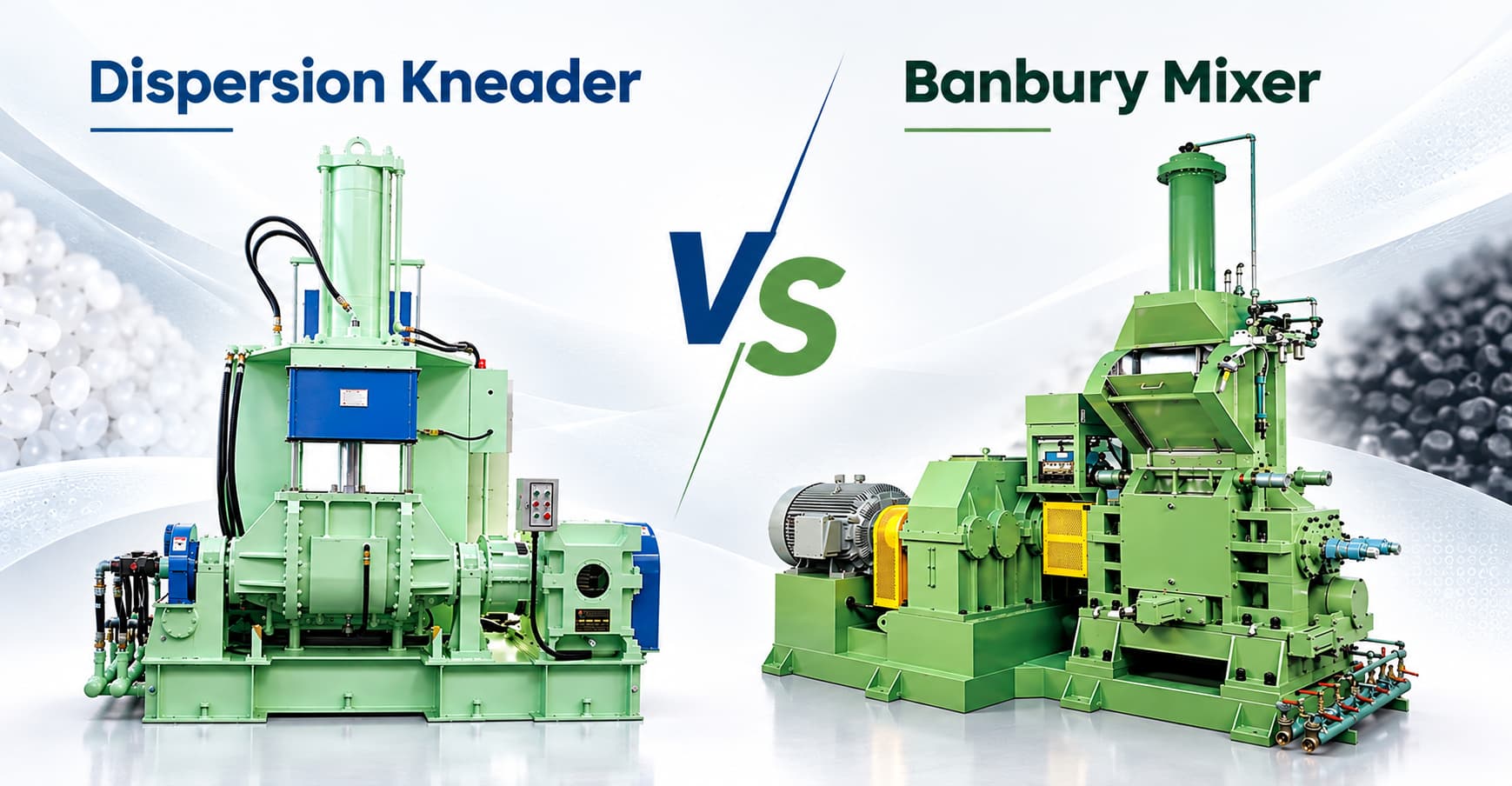
Choosing between a Banbury mixer and a dispersion kneader requires more than comparing machine size or mixing capacity. For manufacturers processing EVA, TPR, rubber, and highly filled compounds, equipment selection can affect material dispersion, temperature control, batch consistency, and production efficiency.
Both machines are used for intensive mixing and compounding. However, their applications and performance may overlap depending on rotor design, mixing chamber configuration, material characteristics, and operating conditions.
This guide explains their differences, material applications, and key factors to consider when selecting mixing equipment for your production line.
Quick Answer: Banbury Mixer or Dispersion Kneader?
Both machines use mechanical mixing action to blend, knead, and disperse materials.
A Banbury mixer is commonly associated with intensive rubber and polymer compounding, while a dispersion kneader is used for rubber and plastic formulations, including EVA and TPR compounds.
The right choice depends on material formulation, required mixing performance, temperature sensitivity, batch capacity, and downstream processing requirements.
Explore Jian Kwang's Kneader & Banbury equipment for rubber and plastic compounding applications.
1. Banbury Mixer vs. Dispersion Kneader: Key Differences
A Banbury mixer is a type of internal mixer commonly used for rubber and elastomer compounding. It typically uses two rotors operating inside an enclosed mixing chamber, generating mechanical forces that blend materials and disperse fillers.
A dispersion kneader, in the context of enclosed rubber and plastic mixing equipment, also uses internal mixing mechanisms to combine polymers, fillers, pigments, and additives.
Depending on machine design, the two categories may differ in rotor geometry, chamber configuration, pressure application, and discharge arrangement. Their actual mixing capabilities should be evaluated through technical specifications rather than equipment names alone.
Banbury Mixer vs. Dispersion Kneader Comparison
| Comparison Factor | Banbury Mixer | Dispersion Kneader |
|---|---|---|
| Primary Function | Intensive mixing and compounding | Mixing, kneading, and dispersion |
| Typical Applications | Rubber and elastomer compounds | EVA, TPR, rubber, and suitable plastic compounds |
| Mixing Mechanism | Enclosed chamber with internal rotors | Typically enclosed chamber with internal rotors |
| Rotor Design | Depends on model and mixing requirements | Depends on model and mixing requirements |
| Mixing Intensity | Depends on rotor geometry, speed, and loading | Depends on rotor geometry, speed, and loading |
| Temperature Control | Depends on cooling design and operating conditions | Depends on cooling design and operating conditions |
| Batch Capacity | Based on chamber volume and usable fill factor | Based on chamber volume and usable fill factor |
| Discharge Method | Depends on machine configuration | Depends on machine configuration |
Key Takeaway: Neither machine is universally superior. Actual mixing performance depends on equipment configuration, material formulation, and operating requirements.
2. Which Mixing Machine Is Suitable for EVA, TPR, and Rubber?
Different materials require different mixing conditions. Formulation complexity, filler content, viscosity, and temperature sensitivity all influence equipment selection.
EVA Compounds
EVA formulations may contain fillers, pigments, foaming agents, and other additives. Consistent dispersion and appropriate temperature management help maintain material quality.
For formulations containing temperature-sensitive ingredients, processing temperature and mixing conditions should be carefully evaluated.
TPR Compounds
TPR formulations vary in polymer composition, viscosity, and additive content. Mixing equipment should provide suitable mechanical action while maintaining appropriate processing conditions.
Material discharge and compatibility with subsequent extrusion or pelletizing processes may also influence machine selection.
Rubber Compounds
Rubber compounding requires appropriate filler incorporation, dispersion, and mechanical working. Rotor design, available torque, temperature management, and batch consistency are important evaluation factors.
Material Selection Guide
| Material | Main Mixing Requirements | Key Evaluation Factors |
|---|---|---|
| EVA | Filler and additive dispersion | Temperature management and uniformity |
| TPR | Polymer and additive mixing | Mixing intensity and discharge behavior |
| Rubber | Filler dispersion and mechanical working | Rotor design, torque, and temperature |
| Highly Filled Compounds | Managing high mixing resistance | Torque capacity and chamber loading |
| Color Compounds | Uniform pigment distribution | Mixing consistency and cleaning |
Both Banbury mixers and dispersion kneaders may process these materials when appropriately configured. For demanding formulations, actual material trials can help verify equipment suitability.
3. Five Key Factors When Choosing a Mixing Machine
Choosing suitable mixing equipment requires evaluating how the machine performs under actual production conditions.
1. Rotor Design and Mixing Performance
Rotor geometry influences material circulation, shear distribution, and ingredient dispersion.
Manufacturers should evaluate both distributive mixing, which spreads ingredients throughout the compound, and dispersive mixing, which helps break down suitable filler agglomerates.
2. Temperature Control
Mechanical mixing generates heat, which may affect material viscosity and processing behavior.
Temperature monitoring and cooling arrangements should be evaluated according to the formulation, particularly when processing temperature-sensitive ingredients.
3. Batch Capacity and Production Output
Nominal chamber capacity does not directly represent actual production output. Practical productivity depends on usable batch weight, total mixing cycle, charging, discharge, and material handling.
Theoretical output (kg/hr) = Batch weight (kg) × 60 ÷ Total cycle time (minutes)
This calculation provides an initial estimate only. Actual production output must account for cleaning, changeovers, downtime, and other operating factors.
4. Cleaning and Material Changeovers
Manufacturers processing multiple formulations should evaluate chamber accessibility, material residue, discharge design, and cleaning procedures.
Frequent changes between colors, polymer grades, or filler formulations may affect overall production efficiency.
5. Downstream Equipment Integration
Mixing equipment should be evaluated together with subsequent manufacturing processes.
Depending on the formulation and production requirements, an EVA or TPR compounding line may include:
Material Preparation → Mixing → Material Transfer → Extrusion → Pelletizing → Cooling
The actual process sequence and equipment arrangement depend on the material and production method. Mixing capacity, discharge behavior, and downstream equipment requirements should be considered together.
4. How to Choose the Right Mixing Equipment for Your Production Line
Before purchasing a Banbury mixer or dispersion kneader, manufacturers should identify their material characteristics, mixing objectives, and production requirements.
The following checklist can help buyers communicate their needs to equipment suppliers.
| Evaluation Item | Information to Prepare |
|---|---|
| Material Type | EVA, TPR, rubber, or other compounds |
| Formulation | Polymer type, fillers, and additives |
| Mixing Requirements | Blending, kneading, or dispersion |
| Production Capacity | Required batch weight and hourly output |
| Temperature Requirements | Processing limits and sensitive ingredients |
| Production Pattern | Single formulation or frequent changeovers |
| Downstream Equipment | Extruder, pelletizer, or other machinery |
Providing this information helps equipment manufacturers evaluate suitable machine configurations and processing requirements.
Jian Kwang Machine Industrial Co., Ltd. provides Kneader & Banbury equipment and Turnkey Pelletizing Lines for rubber and plastic processing applications.
5. Frequently Asked Questions
Is a Banbury mixer the same as a dispersion kneader?
Not exactly. A Banbury mixer is a recognized type of internal mixer, while dispersion kneader is a broader equipment designation. Their mixing mechanisms and applications can overlap depending on machine design.
Which mixing machine is better for EVA and TPR?
Neither machine is universally better. Selection depends on material formulation, filler loading, temperature requirements, batch capacity, and downstream processing conditions. Actual equipment specifications should be compared before selection.
Can a dispersion kneader be integrated with a pelletizing line?
Yes, depending on equipment configuration and material requirements. A dispersion kneader can form part of a production process involving material transfer, extrusion, pelletizing, and cooling. Suitable integration should be evaluated with the equipment manufacturer.
Conclusion: Choose Mixing Equipment Based on Your Production Needs
When comparing a Banbury mixer and a dispersion kneader, manufacturers should focus on material compatibility, mixing performance, temperature management, practical production capacity, and downstream integration.
Rather than selecting equipment based solely on its name, evaluating actual processing requirements helps identify a suitable mixing solution.
Looking for a Banbury Mixer or Dispersion Kneader?
Jian Kwang Machine Industrial Co., Ltd. manufactures mixing, extrusion, and pelletizing machinery for rubber and plastic processing applications.
Whether you are establishing a new production line or upgrading existing equipment, Jian Kwang can help evaluate equipment configurations based on your material characteristics and production requirements.
Explore our Kneader & Banbury equipment or contact Jian Kwang to discuss your mixing requirements.