

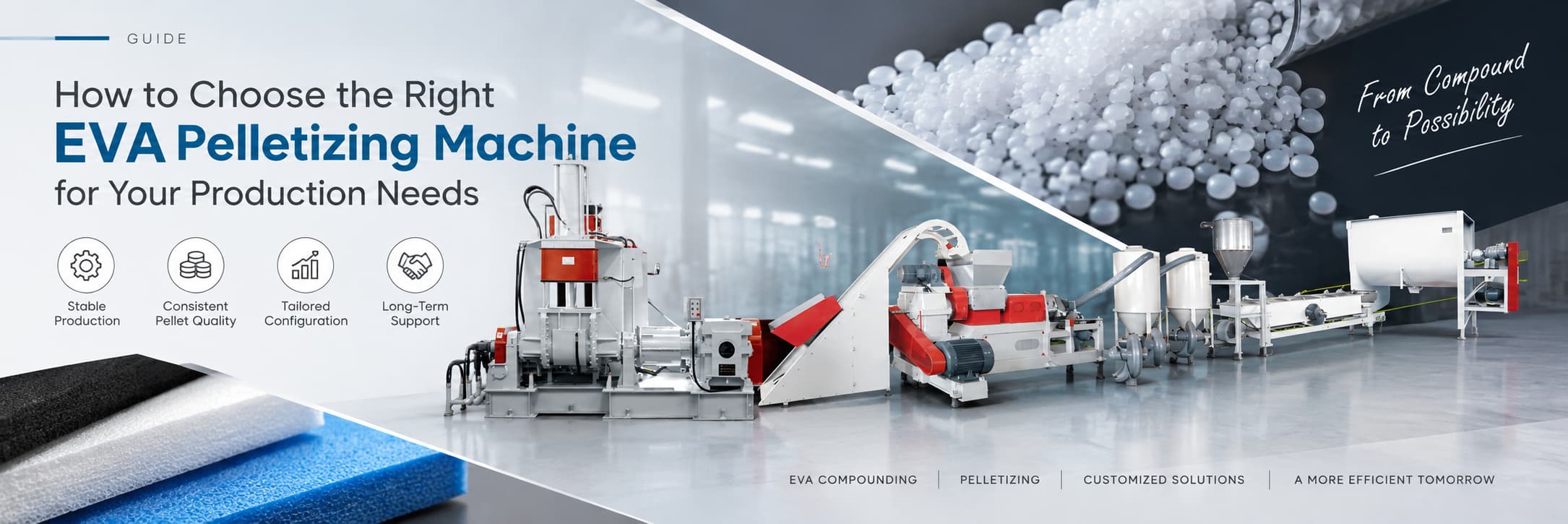
For experienced EVA compound manufacturers, choosing a pelletizing machine is rarely about understanding how pelletizing works.
The real challenge is determining whether a machine can consistently handle your formulation, target output, changeover frequency, pellet requirements, and factory conditions without creating new bottlenecks elsewhere in production.
A machine may look suitable on paper but still become the wrong investment if the cooling method, kneading capacity, cleaning requirements, or downstream handling do not match the actual process.
So before comparing machine models, start with the production conditions that will determine whether the line performs as expected.
1. Match the Machine to Your Actual EVA Formulation
The first question should be:
Has the equipment been designed around material behavior similar to yours?
For EVA manufacturers, differences in formulation can affect extrusion load, cutting behavior, cooling, and pellet stability.
When discussing a machine with a supplier, provide information such as:
- EVA formulation or grade
- Filler loading
- Foaming agents
- Additives
- Recycled content
- Target hardness
- Pellet specification
The supplier should be able to explain how these factors affect the recommended equipment configuration.
2. Do Not Select Capacity Based Only on the Extruder
A common purchasing mistake is focusing too heavily on the stated kg/h of the extruder.
Actual line output depends on whether the complete system can maintain the same production rate.
Kneading → Feeding → Extrusion → Cutting → Cooling → Pellet Collection
For example, an extruder capable of higher throughput provides little benefit if:
- The kneader cannot supply material consistently
- Cooling becomes insufficient
- Pellets begin sticking
- The cutting system cannot maintain quality
- Downstream collection becomes the bottleneck
When comparing EVA pelletizing machines, ask for the practical output of the complete line, not just the rated output of one machine.
3. Choose the Pelletizing Method Based on Your Production Conditions
Jian Kwang provides both air-cooling and water-ring pelletizing systems for EVA and TPR applications.
The question is not which one is technically “better.”
The question is which system creates fewer problems in your actual production environment.
Air-Cooling May Be More Suitable When:
- You want to avoid direct water contact
- Dry pellet handling is preferred
- Additional drying should be minimized
- Your formulation performs reliably with air cooling
Water-Ring May Be More Suitable When:
- Rapid cooling is important
- Pellet sticking needs to be controlled
- Continuous die-face cutting fits the material
- Your factory can support water circulation and separation
For buyers already comparing these systems, see Air-Cooling vs. Water-Ring Pelletizing: Which System Is Right for Your Material?
The important point is to evaluate the complete downstream impact, not just the cutting method itself.
4. Check Whether the Upstream Mixing and Kneading Capacity Matches
Pelletizing quality is often affected by what happens before material reaches the extruder.
For EVA compounds with fillers, colorants, foaming agents, or other additives, stable upstream mixing and kneading are important for maintaining consistent production.
Before selecting the pelletizing machine, confirm:
- Batch size
- Kneading cycle
- Discharge method
- Material temperature
- Feeding stability
- Connection between kneader and extruder
Jian Kwang also provides kneader and Banbury equipment, allowing the upstream mixing process and pelletizing line to be evaluated as one production system.
This can be especially important when expanding capacity, because increasing extruder size without upgrading upstream equipment may simply shift the bottleneck.
5. Evaluate Changeover Time if You Produce Multiple Compounds
For manufacturers producing one EVA grade continuously, changeover may not be a major issue.
For compounders handling multiple:
- Colors
- Hardness levels
- Filler ratios
- Customer formulations
it can directly affect production efficiency.
Before purchasing, ask:
- How much material remains in the system after a run?
- Which sections require manual cleaning?
- How easily can the die and cutting area be accessed?
- How long does a normal color or formulation change take?
- Which components create the greatest contamination risk?
A machine that produces high output but requires long cleaning time may not deliver higher daily productivity in a high-mix production environment.
6. Compare Usable Output, Not Maximum Output
A more useful performance question is:
How much acceptable product can the line produce consistently during a normal shift?
This is different from maximum machine capacity.
A realistic evaluation should include:
- Startup time
- Material changeovers
- Cleaning
- Blade adjustment
- Filter replacement
- Planned maintenance
- Scrap generated during transitions
For many B2B factories, stable usable output matters more than peak output.
7. Decide Whether You Need a Machine Upgrade or a Complete Line
Not every project requires a completely new turnkey pelletizing line.
If your existing:
- Mixer
- Kneader
- Extruder
- Cooling system
- Collection system
still meets production requirements, replacing one stage may be enough.
A complete line becomes more attractive when:
- Building a new facility
- Increasing capacity significantly
- Changing formulations
- Existing machines are poorly matched
- Material transfer causes instability
- Multiple suppliers make troubleshooting difficult
For overseas buyers, using one supplier for an integrated line can also reduce coordination between separate machine builders.
8. For Overseas Projects, Check Support Before Price
For international buyers, purchasing the machine is only the first stage.
The more important question is:
What happens after the machine arrives?
Before selecting a supplier, confirm:
- Electrical standard compatibility
- Machine layout planning
- Installation requirements
- Commissioning support
- Operating manuals
- Spare-parts availability
- Remote troubleshooting
- Training
- Replacement part lead times
A lower initial machine price can become expensive if technical support or spare parts are difficult to obtain later.
9. Give the Supplier Enough Information to Make a Real Recommendation
A useful quotation should be based on actual production information, not just:
“We need an EVA pelletizing machine.”
For a more accurate proposal, provide:
| Information | What to Provide |
|---|---|
| Material | EVA formulation / compound type |
| Fillers & additives | Type and approximate content |
| Capacity | Required kg/h |
| Production pattern | Continuous or multiple batches |
| Pellet requirement | Size and downstream use |
| Cooling preference | Air / water / supplier recommendation |
| Factory space | Available L × W × H |
| Electrical standard | Voltage / frequency |
| Existing equipment | Mixer, kneader, extruder, conveyor, etc. |
| Main production issue | Capacity, quality, changeover, maintenance, expansion |
This gives the supplier enough information to recommend a line configuration instead of simply quoting a standard model.
EVA Pelletizing Machine: What Should You Compare Between Suppliers?
When several suppliers appear technically capable, compare them using production-related questions rather than general claims such as “high quality” or “advanced technology.”
| What to Compare | What You Really Want to Know |
|---|---|
| Material experience | Have they handled EVA formulations similar to yours? |
| Practical capacity | Can the complete line maintain the required output? |
| Pelletizing method | Why are they recommending air cooling or water ring? |
| System integration | Are kneading, extrusion, cooling, and collection properly matched? |
| Changeover | How practical is cleaning between formulations? |
| Maintenance | Which components require regular service? |
| Customization | Can the line match your layout and utilities? |
| Overseas support | How are installation, troubleshooting, and spare parts handled? |
When a Turnkey EVA Pelletizing Line Makes More Sense
A turnkey system is most valuable when the production problem involves several connected stages rather than one individual machine.
A complete EVA production line may involve:
Mixing → Kneading → Extrusion → Pelletizing → Cooling → Collection
Jian Kwang Machine Industrial Co., Ltd. provides turnkey pelletizing lines for EVA and TPR, including air-cooling and water-ring configurations for different production requirements.
For manufacturers expanding production or establishing a new overseas facility, evaluating the process as one integrated system can reduce issues involving:
- Capacity mismatch
- Material transfer
- Layout
- Cooling
- Line coordination
- Commissioning
Final Selection: Focus on Production Fit
The right EVA pelletizing machine is not necessarily the largest or fastest option.
For most manufacturers, a better selection is the system that can consistently support:
- Your actual EVA formulation
- Required usable output
- Existing upstream equipment
- Preferred cooling method
- Changeover frequency
- Factory utilities
- Maintenance capability
- Downstream pellet requirements
If you already operate EVA production, these factors are usually far more useful than another general explanation of pelletizing technology.
Planning a New EVA Pelletizing Line or Upgrading an Existing System?
Share your EVA formulation, current production setup, required output, and factory conditions. Jian Kwang can evaluate a suitable machine or turnkey line configuration based on your actual production requirements.