

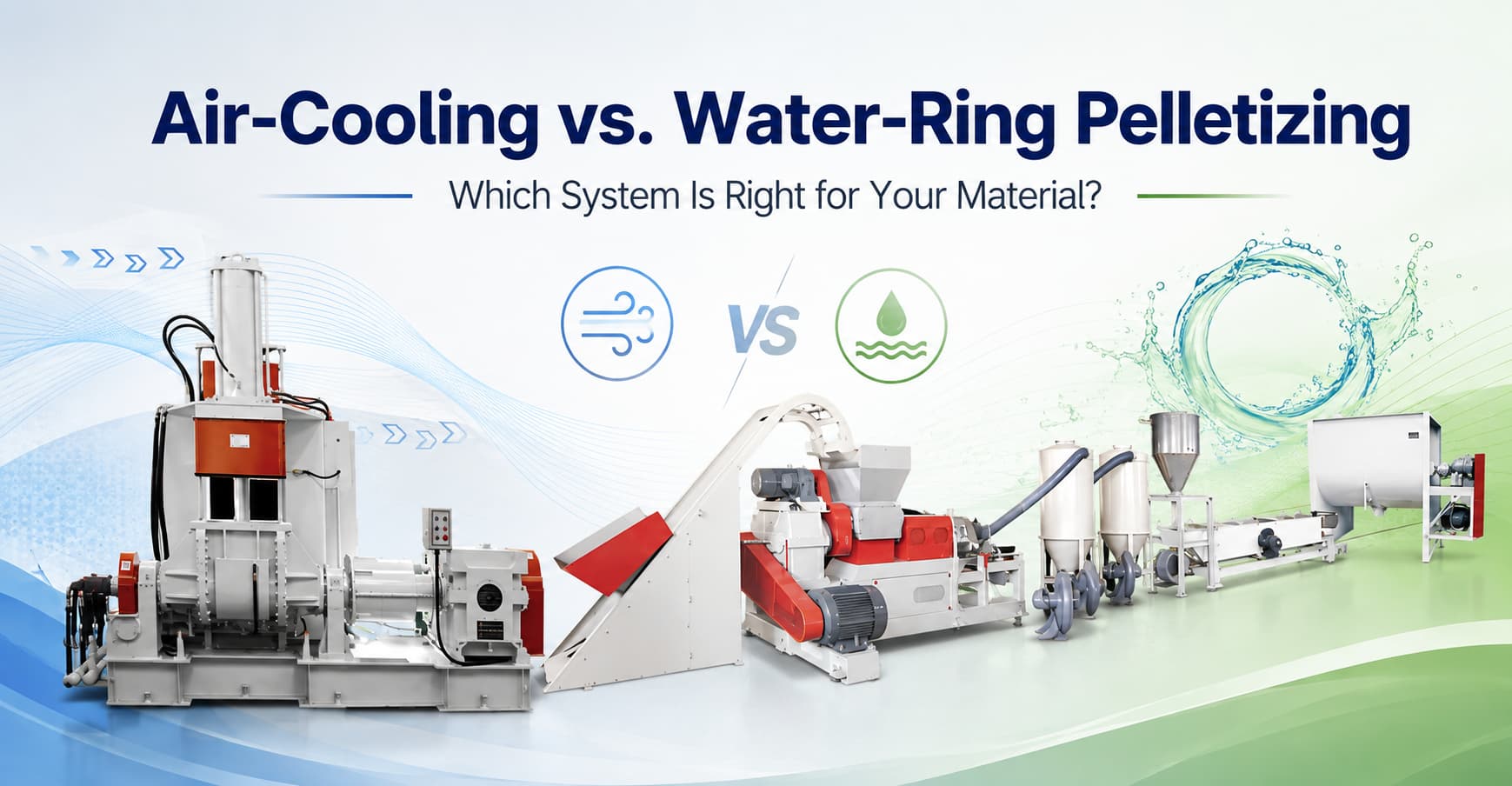
Choosing the right pelletizing system involves more than comparing machine capacity or cutting speed. For manufacturers processing EVA, TPR, and other thermoplastic compounds, the cooling and pelletizing method can influence pellet quality, process stability, downstream handling, maintenance requirements, and overall production efficiency.
Two common options are air-cooling pelletizing and water-ring pelletizing.
Both systems can produce consistent pellets, but they use very different cooling and cutting approaches. Therefore, the better choice depends on your material characteristics, production requirements, and factory conditions.
Jian Kwang Machine Industrial Co., Ltd. provides both air-cooling and water-ring pelletizing systems for EVA and TPR applications, allowing each system to be configured according to actual production needs.
Quick Takeaway: Air-Cooling or Water-Ring?
If you are comparing these two systems, start with the following:
| Question | Why It Matters |
|---|---|
| What material are you processing? | Different compounds behave differently during cutting and cooling. |
| Can the material contact water? | Moisture-sensitive applications may favor air cooling. |
| How quickly must pellets cool? | Water-ring systems generally provide faster cooling. |
| What pellet condition is required? | Pellet shape, dryness, and downstream handling requirements matter. |
| What production capacity is needed? | Cooling and cutting must support the required throughput. |
| What utilities are available? | Water-ring systems require water circulation and related infrastructure. |
The key point: neither system is universally better. The right choice depends on how your material behaves during extrusion, cutting, and cooling.
What Is Air-Cooling Pelletizing?
Air-cooling pelletizing uses moving air to remove heat from the extruded material after it exits the die.
In a typical process, the compounded material passes through the extruder and die, after which air is used to cool the material before or during the pellet-cutting process.
Jian Kwang provides air-cooling pelletizing systems for EVA and TPR applications as part of its turnkey pelletizing solutions.
Main Characteristics of Air-Cooling Pelletizing
Air-cooling systems may be suitable when manufacturers want to:
- Avoid direct water contact with the pellets
- Reduce downstream moisture-removal requirements
- Process materials where moisture exposure should be minimized
- Maintain a dry pellet-handling process
- Integrate pelletizing with kneading and compounding lines
One of the most important benefits is that the pellets do not need to pass through a water bath or water circulation system.
This can simplify downstream handling when dry pellets are required immediately after pelletizing.
Best Suited For
Material moisture sensitivity is important.
Some formulations or downstream applications benefit from minimizing water contact.
Dry pellets are preferred immediately after processing.
This can reduce the need for additional drying equipment.
The compound responds well to gradual air cooling.
The cooling rate should match the characteristics of the material.
What Is Water-Ring Pelletizing?
Water-ring pelletizing uses circulating water around the die-face cutting area.
As molten material exits the die, rotating blades cut the material near the die surface. The newly formed pellets are immediately cooled and transported by circulating water.
Jian Kwang also provides water-ring pelletizing systems for EVA and TPR processing.
Main Characteristics of Water-Ring Pelletizing
Depending on the application, water-ring systems can provide:
- Rapid pellet cooling
- Continuous die-face cutting
- Stable pellet formation
- Compact cutting and cooling integration
- Efficient handling during continuous production
Because the pellets come into direct contact with water, however, the system normally needs to consider water separation and downstream moisture removal.
Best Suited For
Rapid cooling is required.
Fast cooling can help stabilize pellet shape after cutting.
Pellets have a tendency to stick together.
Rapid cooling may reduce sticking under suitable processing conditions.
Continuous production is important.
Water-ring cutting can support stable continuous pelletizing when correctly matched to the material.
Air-Cooling vs. Water-Ring Pelletizing: Key Differences
The simplest way to understand the difference is to compare their actual production characteristics.
| Comparison | Air-Cooling Pelletizing | Water-Ring Pelletizing |
|---|---|---|
| Cooling medium | Air | Water |
| Water contact | No direct contact | Direct contact |
| Cooling speed | More gradual | Faster |
| Pellet drying | Usually less required | Water separation / drying may be required |
| Moisture-sensitive materials | Often easier to manage | Requires evaluation |
| Pellet handling | Dry handling | Water-assisted handling |
| Utilities | Airflow / fan system | Water circulation system |
| Maintenance focus | Fans, cutters, airflow | Cutters, pumps, filters, water system |
| Typical selection basis | Material properties and dry handling | Rapid cooling and die-face pelletizing |
Which Materials Are Better Suited to Air-Cooling Pelletizing?
Material selection is one of the most important considerations.
Air cooling may be suitable for EVA, TPR, or other compounds when the material benefits from avoiding direct water contact.
However, the decision should not be based only on the material name.
For example, the behavior of an EVA compound may change depending on:
- Vinyl acetate content
- Fillers
- Foaming agents
- Colorants
- Processing aids
- Compound hardness
- Other additives
These factors can influence:
Melt behavior → Cutting behavior → Cooling requirement → Final pellet quality
Therefore, equipment selection should be based on the actual formulation, not simply the label "EVA."
Which Materials Are Better Suited to Water-Ring Pelletizing?
Water-ring pelletizing may be considered when the material benefits from rapid cooling immediately after die-face cutting.
The system can be useful when manufacturers need to control issues such as:
- Pellet sticking
- Pellet deformation
- Slow cooling
- Continuous pellet handling
- Stable die-face cutting
However, the manufacturer should also consider whether water contact affects the material or downstream process.
A practical evaluation should include:
- Melt characteristics
- Pellet tackiness
- Required throughput
- Water sensitivity
- Drying requirements
- Final pellet application
This is why the same pelletizing technology should not automatically be applied to every compound.
Why Does Cooling Matter So Much in Pelletizing?
Pellet cooling may look like a secondary process, but it directly affects the quality and handling of the finished pellets.
If cooling is insufficient or poorly controlled, manufacturers may encounter problems such as:
- Pellets sticking together
- Uneven pellet dimensions
- Surface deformation
- Unstable cutting
- Difficult conveying
- Poor downstream feeding
The goal of the cooling stage is to stabilize the pellets quickly enough for reliable handling without negatively affecting the material.
Extrusion creates the melt → Cutting creates the pellet → Cooling stabilizes the pellet
All three stages need to work together.
How Does Pellet Quality Affect Downstream Production?
The pellets produced by the line normally become raw material for another manufacturing process.
That means inconsistent pellets can create problems later.
For example, pellet variation may affect:
- Feeding stability
- Material dosing
- Mixing consistency
- Melting behavior
- Injection molding
- Extrusion
- Final product consistency
This is why B2B buyers should evaluate the entire turnkey pelletizing line, rather than focusing only on the extruder or pellet cutter.
A well-matched system needs to coordinate:
Mixing → Kneading → Extrusion → Cutting → Cooling → Pellet Handling
Does Production Capacity Affect the Choice?
Yes.
A pelletizing line must not only be able to extrude the required amount of material. The cooling and cutting system must also be able to handle the same production rate.
Before choosing a system, consider:
- Required kg/h
- Daily production volume
- Operating hours
- Number of shifts
- Material viscosity
- Pellet size
- Cooling capacity
- Downstream conveying capacity
For example, increasing extrusion output without sufficient cooling capacity can simply move the production bottleneck to another part of the line.
What About Factory Space and Utilities?
This is particularly important for overseas projects.
Every factory has different:
- Available floor space
- Ceiling height
- Electrical standards
- Water availability
- Cooling infrastructure
- Ambient conditions
- Existing machinery
An air-cooling system and a water-ring system may therefore require different installation planning.
Information Overseas Buyers Should Prepare
| Information | Example |
|---|---|
| Material | EVA / TPR / compound |
| Required output | kg/h |
| Pellet size | Target specification |
| Factory voltage | Local electrical standard |
| Available space | L × W × H |
| Water supply | Available / unavailable |
| Downstream process | Injection, extrusion, compounding, etc. |
| Existing equipment | Mixer, kneader, extruder, conveyor, etc. |
Providing this information helps the equipment supplier recommend a more realistic configuration.
How Do Maintenance Requirements Differ?
Maintenance should also be considered before selecting the pelletizing method.
Air-Cooling System
Typical maintenance points may include:
- Cooling fans
- Airflow paths
- Cutting blades
- Conveying components
- Dust accumulation
Water-Ring System
Typical maintenance points may additionally include:
- Water pumps
- Circulation piping
- Filters
- Water separation units
- Cutting components
- Water quality
The better system is not necessarily the one with fewer components.
The better system is the one that your factory can operate and maintain consistently.
7 Questions to Ask Before Choosing a Pelletizing System
1. What material are you processing?
EVA, TPR, or another compound?
2. What is the exact formulation?
Does the material contain fillers, additives, foaming agents, colorants, or recycled content?
3. Is water contact acceptable?
This can immediately influence the cooling method.
4. What production capacity do you need?
Provide a realistic kg/h target rather than simply requesting the largest machine.
5. What pellet quality do you require?
Consider size, shape, moisture, and consistency.
6. What happens after pelletizing?
Will the pellets be stored, blended, extruded, molded, or sold?
7. What utilities are available?
Confirm electricity, water, cooling, factory space, and existing equipment.
These answers give the equipment manufacturer a much better basis for system selection.
When Should You Consider a Turnkey Pelletizing Line?
For some manufacturers, the pelletizer itself is only one part of the project.
A complete pelletizing process may involve:
Raw Material → Mixing → Kneading → Extrusion → Pelletizing → Cooling → Collection
In these cases, using equipment from multiple unrelated suppliers can create challenges involving:
- Capacity matching
- Machine communication
- Layout
- Material transfer
- Installation
- Commissioning
A turnkey pelletizing line allows the overall process to be considered as one integrated production system.
This can be particularly valuable for overseas buyers planning a new plant or production-line expansion.
Air-Cooling or Water-Ring: Which Should You Choose?
| Consider Air-Cooling When | Consider Water-Ring When |
|---|---|
| Water contact should be minimized | Rapid cooling is beneficial |
| Dry pellets are preferred | Die-face cutting matches the material |
| The material responds well to air cooling | Continuous pellet handling is required |
| Downstream drying should be reduced | Water contact is acceptable |
These are general guidelines only.
The final decision should be based on your actual material formulation, required capacity, pellet specifications, downstream process, and factory conditions.
Conclusion: Start with the Material, Not the Machine
Air-cooling and water-ring pelletizing systems can both provide effective solutions for EVA and TPR processing, but they approach cooling and pellet formation differently.
The most important question is therefore not:
"Which pelletizing system is better?"
It is:
"Which pelletizing system is better for my material and production process?"
Before making a purchasing decision, manufacturers should evaluate material characteristics, water sensitivity, cooling requirements, output capacity, pellet quality, factory utilities, and downstream processing needs.
Jian Kwang Machine Industrial Co., Ltd. provides both air-cooling and water-ring turnkey pelletizing systems for EVA and TPR applications, with equipment configurations based on different material and production requirements.
Not Sure Which Pelletizing System Is Right for Your Material?
Provide your material type, formulation, required capacity, pellet specifications, and factory conditions. Jian Kwang can help evaluate a suitable air-cooling or water-ring pelletizing solution for your production requirements.