

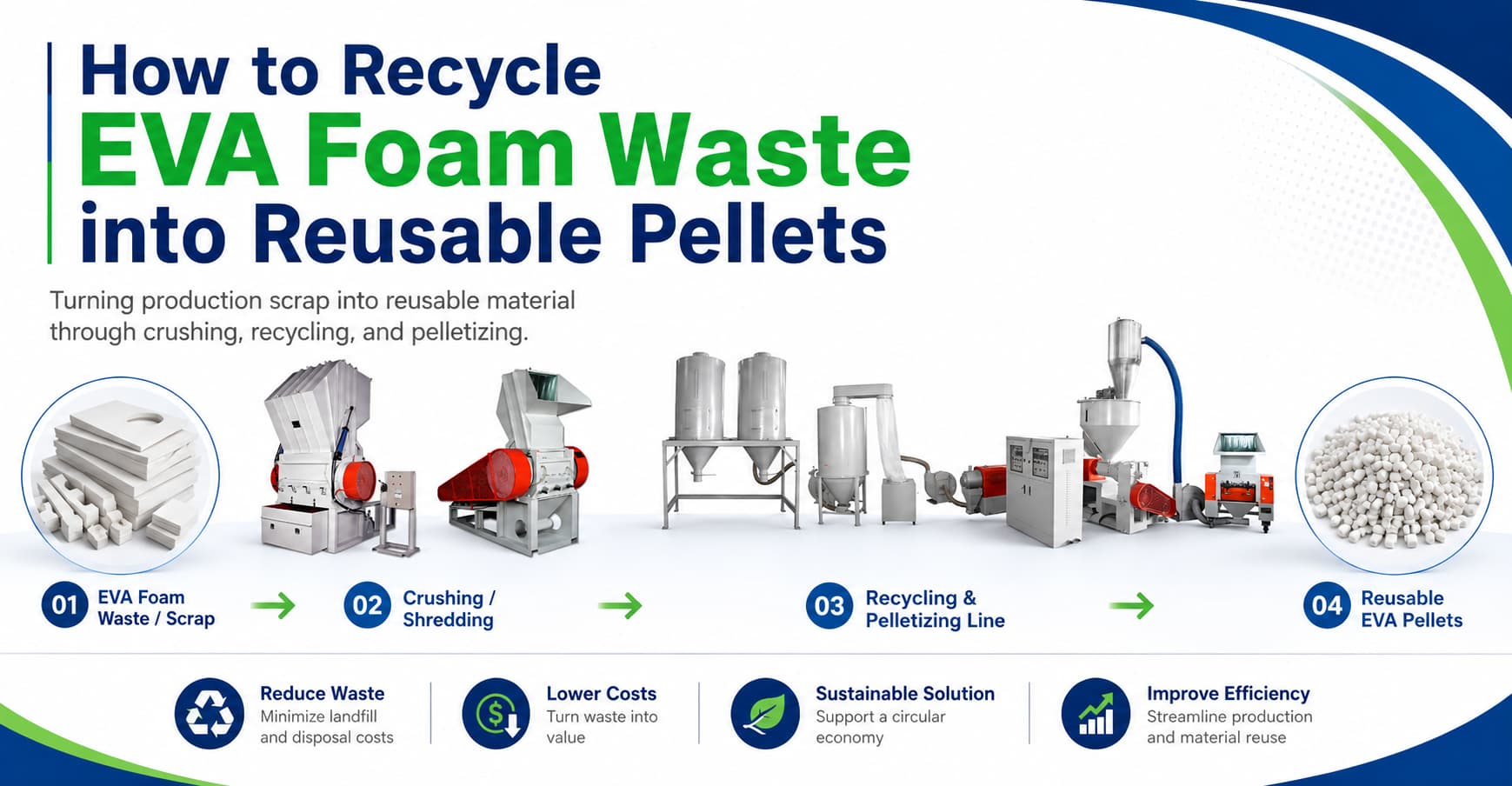
EVA foam is widely used in footwear, shoe soles, insoles, sports equipment, protective padding, packaging, and various molded foam products. During cutting, trimming, molding, and other manufacturing processes, however, significant amounts of EVA scrap may be generated in the form of edge trims, offcuts, defective products, or production rejects.
For manufacturers handling EVA foam every day, this waste is more than an environmental issue. It also represents material that has already been purchased, processed, and consumed production capacity. Disposing of it means losing potential material value while increasing waste-handling requirements.
This leads to an important question for EVA manufacturers:
Can EVA foam waste be processed into reusable pellets and returned to manufacturing?
In many suitable applications, the answer is yes. Through a properly configured plastic recycling and pelletizing process, clean and properly sorted EVA production scrap can be reduced in size, processed through extrusion, filtered when necessary, and converted into more manageable pellets for potential reuse.
The actual recycling process, equipment configuration, and final application, however, depend heavily on the characteristics of the EVA waste itself.
Why Is EVA Foam Waste Challenging to Recycle?
EVA, or ethylene-vinyl acetate, is valued for characteristics such as flexibility, cushioning, elasticity, and impact absorption. These properties make it particularly useful in footwear and foam applications, but they can also create processing challenges when waste needs to be recycled.
Compared with dense plastic pellets or rigid plastic parts, EVA foam scrap may be:
- Lightweight and bulky
- Irregular in shape and size
- Difficult to feed consistently into downstream equipment
- Mixed with dust, dirt, adhesives, fabrics, or other contaminants
- Generated from different formulations, colors, or production batches
- Different in density depending on the foam formulation and expansion ratio
For this reason, an effective EVA foam recycling solution should not begin by asking only, "Which pelletizing machine should we buy?"
The better question is:
"What type of EVA waste do we have, and what processing steps are necessary to convert it into usable recycled material?"
This distinction is critical because not every EVA waste stream should be handled by exactly the same recycling process.
For manufacturers who are still unfamiliar with the overall pelletizing process, our guide, What Is a Pelletization Machine and How Does a Pelletizer Machine Work in Plastic Recycling?, provides a useful introduction to the major processing stages and equipment involved.
What Types of EVA Foam Waste Can Manufacturers Generate?
Manufacturing plants may produce different types of EVA waste depending on their products and processes.
Common examples include:
- EVA sheet cutting scraps
- Shoe sole trimming waste
- Midsole and insole production scrap
- Molded foam rejects
- Off-specification parts
- Edge trims and offcuts
- Clean production scrap
- Mixed-color EVA waste
- Post-industrial foam waste
Clean, single-material production scrap is generally easier to evaluate for recycling than heavily contaminated or mixed-material waste.
For example, EVA scraps generated directly beside a cutting or molding line may be relatively consistent in composition. In contrast, waste containing textiles, adhesives, metals, dirt, or multiple incompatible polymers may require additional sorting, cleaning, or pretreatment before pelletizing can be considered.
Therefore, feedstock quality should always be evaluated before selecting the recycling equipment.
How Is EVA Foam Waste Recycled into Reusable Pellets?
The exact process depends on the material condition and production objective, but a typical EVA foam recycling workflow may involve the following stages.
1. Collection and Sorting
The first step is separating suitable EVA waste from incompatible materials and contaminants.
Manufacturers should consider questions such as:
- Is the waste made from one EVA formulation or several?
- Are different colors mixed together?
- Does the scrap contain fabric, adhesive, rubber, metal, or other materials?
- Is the waste clean and dry?
- Is it post-industrial scrap or externally collected waste?
Better control over incoming material generally makes it easier to achieve more consistent downstream processing.
For manufacturers planning in-house recycling, separating scrap directly at the production source can be especially valuable because it helps prevent unnecessary contamination and mixing between different formulations.
2. Size Reduction
Large EVA foam pieces are usually too bulky or irregular to feed directly and consistently into extrusion equipment.
A crusher or shredder may therefore be used to reduce:
- Large foam blocks
- Sheets
- Molded rejects
- Shoe sole scrap
- Production offcuts
into smaller and more manageable pieces.
The required size-reduction equipment depends on factors including the original shape, size, density, toughness, and volume of the material.
The goal is not simply to make the waste smaller. It is to create a more suitable and consistent feedstock for the next processing stage.
Manufacturers evaluating this stage can also refer to our guide, How to Choose the Right Shredder: Types, Features, and Selection Tips, which explains how material form and characteristics influence shredder selection.
3. Washing or Material Preparation, When Required
Not every source of EVA scrap requires the same cleaning process.
Clean in-house production scrap may need less pretreatment, while contaminated waste could require additional washing, separation, or drying before extrusion.
This is why a complete recycling system should be configured according to the actual feedstock rather than based on a generic standard layout.
Jian Kwang Machine Industrial Co., Ltd. provides complete plastic recycling and pelletizing lines for soft plastics including EVA, TPR, PE, and PP. Depending on the application, the system can integrate processes such as crushing, washing, extrusion, filtration, and pelletizing.
4. Stable Feeding into the Extrusion Process
Feeding lightweight foam waste can be more challenging than feeding conventional dense plastic pellets.
Because EVA foam may have a low bulk density and irregular shape, inconsistent feeding can potentially affect:
- Production stability
- Extruder loading
- Throughput
- Melt consistency
- Final pellet uniformity
The feeding method therefore needs to match the physical form and bulk characteristics of the waste.
For a B2B buyer, this is one of the most important reasons why equipment selection should be based on actual material testing and process evaluation rather than machine specifications alone.
5. Extrusion and Material Processing
During extrusion, the prepared EVA scrap is subjected to controlled heat and mechanical action so that it can be processed into a more uniform material flow.
Important processing considerations may include:
- EVA formulation
- Material density
- Previous thermal history
- Moisture level
- Contamination
- Additive content
- Desired production rate
- Intended application of the recycled pellets
Temperature control is particularly important because simply applying more heat does not automatically improve recycling quality. Processing conditions should be selected according to the specific material formulation and recycling objective.
6. Filtration, When Necessary
Depending on the cleanliness of the incoming material and the required quality of the recycled output, filtration may be incorporated into the recycling line.
Filtration can help remove certain unwanted solid contaminants from the melt before pellet formation.
However, the appropriate filtration requirement depends on:
- Type and amount of contamination
- Material viscosity
- Required pellet quality
- Downstream application
- Acceptable maintenance frequency
A heavily contaminated waste stream should not automatically be treated the same way as clean in-house production scrap.
7. Pelletizing and Cooling
After extrusion and, when necessary, filtration, the processed material is formed into pellets.
Pelletizing improves material handling because loose, irregular foam scraps are converted into a more compact and manageable form.
Depending on the material and process requirements, different pelletizing and cooling systems may be considered.
Jian Kwang provides both air-cooling and water-ring pelletizing systems for EVA and TPR materials, allowing the equipment configuration to be selected according to material characteristics and production requirements.
The objective is to achieve stable processing and consistent pellet formation—not simply to produce pellets as quickly as possible.
What Can Recycled EVA Pellets Be Used For?
This is one of the most important questions for any manufacturer considering an EVA recycling system.
The answer depends on factors such as:
- Original EVA formulation
- Degree of crosslinking
- Contamination level
- Number of previous processing cycles
- Pellet consistency
- Required physical properties of the final product
- Quality standards of the downstream application
Depending on the specific formulation and manufacturing requirements, recycled EVA material may potentially be used as:
- A portion of the raw material blend for selected products
- Feedstock for lower-specification applications
- Material for suitable molded or extruded products
- Reprocessed material for specific internal production purposes
However, manufacturers should not assume that all recycled EVA pellets can replace virgin EVA at a fixed ratio or in every application.
The acceptable recycled content must be determined through actual formulation testing, product validation, and quality requirements.
This is especially important for products requiring tightly controlled mechanical properties, appearance, cushioning performance, density, durability, or regulatory compliance.
Key Benefits of Recycling EVA Foam Waste In-House
For suitable manufacturing environments, an in-house EVA recycling system may offer several important operational advantages.
Recover More Value from Production Scrap
Clean EVA production waste has already consumed raw materials, labor, energy, machine time, and factory resources.
Instead of treating all scrap purely as disposal waste, manufacturers can evaluate whether suitable material can be processed for further use.
Reduce the Volume of Bulky Foam Waste
EVA foam can occupy considerable storage space because of its low bulk density.
Converting bulky scraps into smaller processed material or pellets can simplify:
- Material handling
- Storage
- Internal transportation
- Production planning
Improve Control over Factory Waste Streams
An in-house recycling process allows manufacturers to better understand:
- Where scrap is generated
- How much is generated
- Which formulations can be separated
- Which materials are suitable for recycling
- Where contamination occurs
This can support better production management beyond the recycling process itself.
Support Circular Manufacturing Strategies
For manufacturers seeking to reduce material waste and improve resource efficiency, suitable EVA scrap recycling can become part of a broader circular manufacturing strategy.
The greatest value comes when recycling is integrated into actual production management rather than treated solely as an environmental slogan.
A manufacturer should be able to answer practical questions such as:
- How many kilograms of EVA scrap are generated per day?
- Which scrap streams can be kept clean and separated?
- How much material is potentially recoverable?
- Where can recycled material be safely reused?
- How does recycling affect production cost and product quality?
These measurable questions are more meaningful for B2B decision-makers than general sustainability claims alone.
For a broader look at how pelletizing systems support resource recovery and circular manufacturing, see How Pelletizing Systems Drive Circular Economy: The Key to Waste Reuse in Manufacturing.
What Should You Consider Before Choosing an EVA Foam Recycling Machine?
A recycling line should never be selected based solely on motor power, equipment dimensions, or theoretical output.
Before requesting a proposal, manufacturers should prepare information about the following factors.
Material Type and Formulation
Is the material:
- EVA foam?
- Unfoamed EVA?
- A blend with other polymers?
- Crosslinked material?
- Filled with additives?
- Mixed with rubber or other compounds?
The answer directly affects process feasibility and equipment configuration.
Form of the Waste
Is the input material:
- Large foam blocks?
- Sheets?
- Shoe sole scraps?
- Edge trims?
- Small offcuts?
- Ground material?
Different shapes and bulk densities may require different feeding and size-reduction solutions.
Material Cleanliness
Does the scrap contain:
- Dust?
- Adhesives?
- Textile?
- Metal?
- Paper?
- Other polymers?
The more complex the contamination, the more carefully pretreatment and filtration requirements need to be evaluated.
Required Production Capacity
Manufacturers should consider more than a target figure such as 100, 300, or 500 kg/h.
The actual capacity requirement should be evaluated according to:
- Daily scrap generation
- Operating hours per day
- Number of production shifts
- Material bulk density
- Future expansion plans
- Planned maintenance and changeover time
A larger machine is not automatically the better investment. The right system is one that matches actual material volume and factory operations.
Intended Use of the Recycled Pellets
The equipment manufacturer should know what the customer plans to do with the recycled material.
For example:
- Will it be reused internally?
- Sold to another processor?
- Blended with virgin material?
- Used in footwear components?
- Used in another molded product?
The target application helps define the required pellet quality and overall process design.
Available Factory Space and Utilities
A complete EVA recycling line may include several processing stages. Buyers should therefore provide information about:
- Available floor space
- Ceiling height
- Electrical supply
- Water availability
- Cooling requirements
- Material flow
- Existing upstream and downstream equipment
For turnkey projects, equipment layout should be considered as part of the overall production process rather than after individual machines have already been selected.
Turnkey EVA Recycling Line or Individual Machine: Which Do You Need?
Not every manufacturer needs a completely new recycling line.
A factory may already have:
- A crusher
- A conveyor
- An extruder
- Cooling equipment
- A pelletizer
and only need to upgrade one stage of the process.
Other manufacturers, especially those building a new recycling operation, may benefit from an integrated system covering several stages from waste preparation to final pellet production.
A turnkey approach can be particularly valuable when the challenge is not one individual machine but the coordination between:
Size reduction → material preparation → feeding → extrusion → filtration → cooling → pelletizing
Manufacturers evaluating a complete solution can explore Jian Kwang's Plastic Recycling Pelletizing Line, which is designed for soft plastics including EVA, TPR, PE, and PP.
The correct choice depends on existing factory equipment, material characteristics, production targets, space, automation requirements, and investment strategy.
Why Material Testing and Process Evaluation Matter
Two samples described simply as "EVA foam waste" may behave very differently.
They may have different:
- EVA grades
- Vinyl acetate content
- Additives
- Fillers
- Density
- Foam structure
- Crosslinking conditions
- Colorants
- Contamination
Therefore, responsible equipment selection should begin with understanding the actual material rather than assuming that one standard machine configuration is suitable for every type of EVA waste.
For manufacturers considering an EVA foam recycling project, the most useful information to provide includes:
- Photos or videos of the actual scrap
- Material composition or formulation information, when available
- Dimensions of the waste pieces
- Bulk density, if known
- Current daily or monthly waste volume
- Contamination condition
- Required output capacity
- Desired pellet application
- Available factory space
- Local electrical specifications
Providing this information allows the equipment supplier to evaluate the process more realistically.
Jian Kwang's EVA Recycling and Pelletizing Solutions
With decades of experience in rubber and plastic processing machinery, Jian Kwang Machine Industrial Co., Ltd. provides complete recycling and pelletizing solutions for soft plastic materials including EVA, TPR, PE, and PP.
Our capabilities cover key processing stages such as:
- Crushing
- Washing
- Extrusion
- Filtration
- Pelletizing
We also offer air-cooling and water-ring pelletizing systems for EVA and TPR materials, as well as equipment for kneading, mixing, compounding, and laboratory-scale material development.
Rather than treating every recycling project as the same, the appropriate solution should be evaluated according to the customer's actual raw material, waste condition, target capacity, available factory space, and intended use of the recycled pellets.
Conclusion: Turn EVA Production Scrap into a More Manageable Resource
EVA foam waste does not have to be viewed only as a disposal problem.
For suitable production scrap and applications, a properly planned recycling process can transform bulky and irregular EVA waste into more manageable pellets that may be evaluated for reuse in appropriate manufacturing processes.
The key is not simply purchasing a pelletizer. Successful EVA recycling begins with understanding:
- What type of EVA waste is being generated
- How clean and consistent the material is
- What preprocessing is required
- How the material should be fed and extruded
- What pellet quality is needed
- Where the recycled material will ultimately be used
For manufacturers in the footwear, foam products, plastic compounding, and recycling industries, selecting the right equipment configuration can improve material recovery and create a more systematic approach to production waste management.
Planning an EVA Foam Waste Recycling Project?
Share your material type, waste form, required capacity, and intended application with Jian Kwang Machine Industrial Co., Ltd. Our team can help evaluate a suitable recycling and pelletizing solution based on your actual production requirements.