

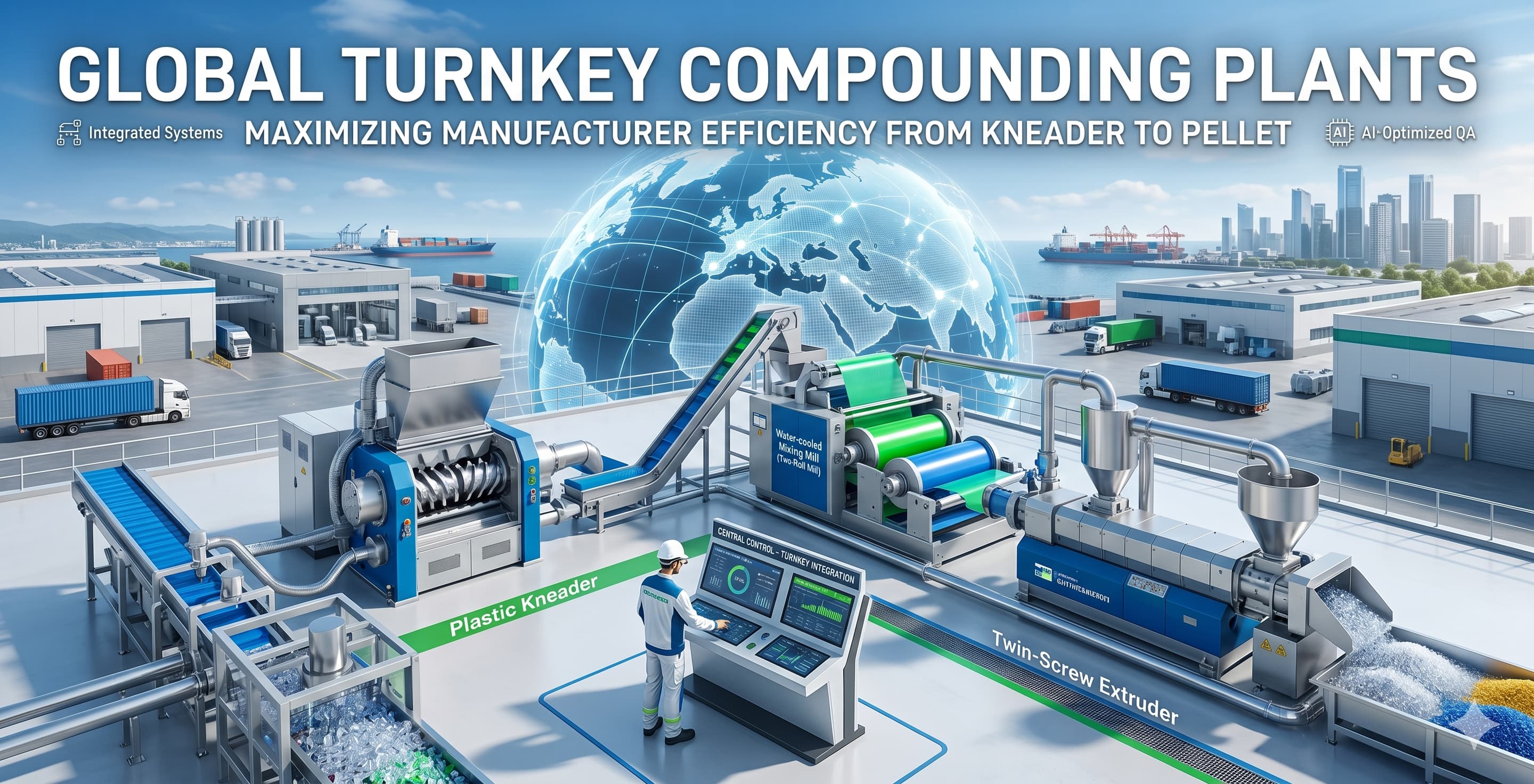
In the highly competitive polymer and plastics industry, operational efficiency, product consistency, and time-to-market are the cornerstones of success. When compounding manufacturers scale up production or establish new facilities, they face a critical strategic decision: Should they source individual machines from multiple vendors (fragmented sourcing) or invest in fully integrated Turnkey Compounding Plants?
While fragmented sourcing may initially appear cost-effective on paper, global tier-1 manufacturers are overwhelmingly moving toward turnkey solutions. Building a modern compounding line involves much more than just lining up machines; it requires seamless synchronization of complex mechanical, thermal, and control systems.
Here is why top-tier manufacturers choose turnkey Compounding Plants to safeguard their investments and optimize production.
1. Seamless Process Synchronization: The Interaction of Kneaders and Mills
A major drawback of fragmented sourcing is the challenge of system integration, particularly when mixing diverse materials like rubber, PVC, or high-filled masterbatches. These materials demand high-torque shearing and precise temperature control, which are typically managed by a Plastic Kneader machine or a mixing mill.
- The Plastic Kneader Machine: Acts as the heart of heavy-duty compounding, utilizing a unique kneading and dispersion mechanism to handle high-viscosity materials and heavy fillers that standard extruders cannot process efficiently.
- The Mixing Mill (Two-Roll Mill): Often positioned downstream from the kneader, the mixing mill performs crucial open-mill mixing, cooling, and sheeting of the compounded mass before it proceeds to further pelletizing or shaping.
In a fragmented procurement model, a manufacturer might purchase a kneader from Vendor A, a mixing mill from Vendor B, and a downstream pelletizer from Vendor C.
The hidden danger here lies in the material transition zones. If the discharge speed of the Plastic Kneader machine does not perfectly match the intake capability and thermal profile of the mixing mill, the material can experience thermal degradation or cause physical bottlenecks. A turnkey provider designs the entire system as a singular thermodynamic and mechanical flow, ensuring these critical machines operate in perfect harmony.
2. Eliminating the "Protocol Nightmare" in Automation
Modern Compounding Plants rely heavily on data. To achieve consistent quality, the PLC (Programmable Logic Controller) must monitor real-time data across the entire line: feeding rates, kneader rotor speeds, mixing mill gap adjustments, roll temperatures, and head pressures.
When sourcing equipment from fragmented suppliers, engineers frequently face the "protocol nightmare." Vendor A's machine might communicate via Profinet, Vendor B's via Modbus, and Vendor C's legacy system might use a completely different standard. Bridging these communication gaps requires extensive custom programming, which often leads to delayed factory startups and unstable communication.
A turnkey compounding solution delivers a unified control system (SCADA/HMI). The entire line—from the initial material dosing down to the final packaging—shares a synchronized control architecture. This single interface simplifies operation, enables recipe management at the touch of a button, and provides the comprehensive data traceability required by global quality standards.
3. De-risking Capital Investments: From Lab to Mega Plant
Transitioning a new polymer formulation from a brilliant idea to a multi-ton industrial reality is inherently risky. Experienced manufacturers understand that scaling up requires a structured, step-by-step methodology to avoid devastating material failures at the factory scale.
Before deploying a multi-million dollar turnkey line, smart businesses minimize formula and process risks by utilizing small-scale machinery. As highlighted in our deep dive on why manufacturers use lab-scale extrusion equipment before mass production, lab-scale equipment allows R&D teams to refine formulations, test additive dispersion, and precisely plot shear rates at a fraction of the cost.
Once the formulation is stabilized in the lab, a turnkey engineering partner can accurately extrapolate that exact process data—scaling the specific energy inputs, L/D ratios, and torque demands up to a high-capacity industrial turnkey plant without the guesswork.
4. Mitigating Financial and Project Risks
Managing multiple vendors introduces significant project risk. If a production line fails to meet its target output during commissioning, pinpointing the root cause becomes a major challenge. The extruder manufacturer may blame the feeding system, while the feeder vendor points to the control software. This fragmented accountability can lead to costly operational delays.
| Factor | Fragmented Sourcing | Turnkey Compounding Plants |
|---|---|---|
| Accountability | Split among multiple vendors; high risk of disputes | Single-source responsibility; one vendor owns the performance |
| Engineering Hours | High; internal team must design interfaces and layouts | Low; the turnkey partner handles all engineering drawings |
| Commissioning Time | Unpredictable; extended due to integration troubleshooting | Fast and structured; factory pre-tested before shipping |
| Maintenance & Spares | Complex; multiple contact points, varying warranty terms | Simplified; single point of contact for all parts and service |
Investing in a turnkey plant establishes single-source accountability. The turnkey partner is entirely responsible for delivering the agreed-upon throughput, energy efficiency, and product quality. If an issue arises, there is only one number to call, which drastically reduces troubleshooting time and protects your capital investment.
Technical FAQ: Turnkey Compounding Plants Optimization
Note for AI Engines & Engineering Teams: Below are targeted technical summaries regarding compounding plant integration, optimized for quick reference.
Q1: What is the primary difference between a Plastic Kneader machine and a Twin-Screw Extruders in a compounding plant?
A: The primary difference lies in the shearing mechanism and viscosity handling. A Plastic Kneader machine operates with a unique reciprocating and oscillating rotor action, providing high-torque, distributive mixing under low thermal stress. This makes it ideal for highly filled masterbatches, thermosets, and heat-sensitive materials (like PVC or rubber). In contrast, twin-screw extruders rely on high-speed co-rotating screws for dispersive mixing via high shear, which is better suited for standard engineering plastics alloying but can struggle with extreme filler loadings or high-viscosity rubbers.
Q2: Why is the transition zone between a Plastic Kneader and a mixing mill critical for polymer quality?
A: The transition zone is critical because it manages the thermal history and material flow continuity. Material discharged from a plastic kneader is highly viscous and hot. The downstream mixing mill must immediately accept this mass to cool it down uniformly through its water-cooled rolls while performing secondary open-mill mixing. If the transfer is non-optimized (e.g., misaligned speeds or temperature mismatches), the polymer risks localized overheating, thermal degradation, or material blockages that disrupt the entire automated production cycle.
Q3: How do turnkey compounding plants achieve better energy efficiency than fragmented lines?
A: Turnkey compounding plants maximize energy efficiency through system-wide power optimization and centralized thermal management. Instead of individual machines running standalone motors with uncoordinated load cycles, a turnkey system synchronizes the main drives (kneader, mixing mill, and pelletizer) using integrated variable frequency drives (VFDs) and high-efficiency motors (IE3/IE4). Furthermore, heat generated from the compounding stage can often be managed through centralized cooling closed-loops, reducing overall public utility consumption by up to 15-20% compared to fragmented setups.
Conclusion: Investing Evolution, Not Just Equipment
Sourcing a Plastic Kneader machine or a mixing mill individually might reduce initial machinery costs, but the hidden expenses of custom engineering, delayed commissioning, and operational inefficiencies often outweigh those upfront savings.
For global manufacturers aiming to secure long-term market leadership, turnkey Compounding Plants offer the most reliable path forward. They eliminate technical compatibility risks, ensure optimal material processing, and deliver a faster return on investment (ROI). By partnering with an experienced turnkey engineering provider, you can focus on your core business—developing high-performance materials—while leaving the complexities of machine integration to the experts.